
Anatolian Cotton: a softer connection to home


The towel we reach for after washing our hands is often a small detail in the day. Yet that familiar texture has a longer story. Cotton is opened, fibres are arranged, yarns are prepared, and a looped surface gradually takes shape. Look a little closer, and an everyday object becomes a rather remarkable transformation.
The scenes in our Cotton to Towel film follow a common route for woven cotton terry. Here, we explore that journey in six stages. Manufacturing methods and the order of treatments can vary with the fabric and the product.
At the beginning, there is no towel, or even a yarn. Cotton arrives in compressed bales, which are opened, blended and cleaned. Carding then separates and aligns the fibres, gathering them into a continuous strand known as a sliver.
It is not easy to picture a finished towel when looking at the raw cotton in the film. That is part of the fascination: fibres that seem loose and unconnected gradually become the starting point for an organised textile surface.

Drawing helps make the fibre strands more even. In the ring-spinning route shown in the film, the fibres are first prepared as finer roving, then drawn and twisted into yarn. The yarn is subsequently wound onto packages suited to the next production stages.
Large masses of cotton have now given way to fine, continuous lines. This is a useful moment to think about a towel’s less visible structure: the story of the fabric we touch is also held in the yarns from which it is made.

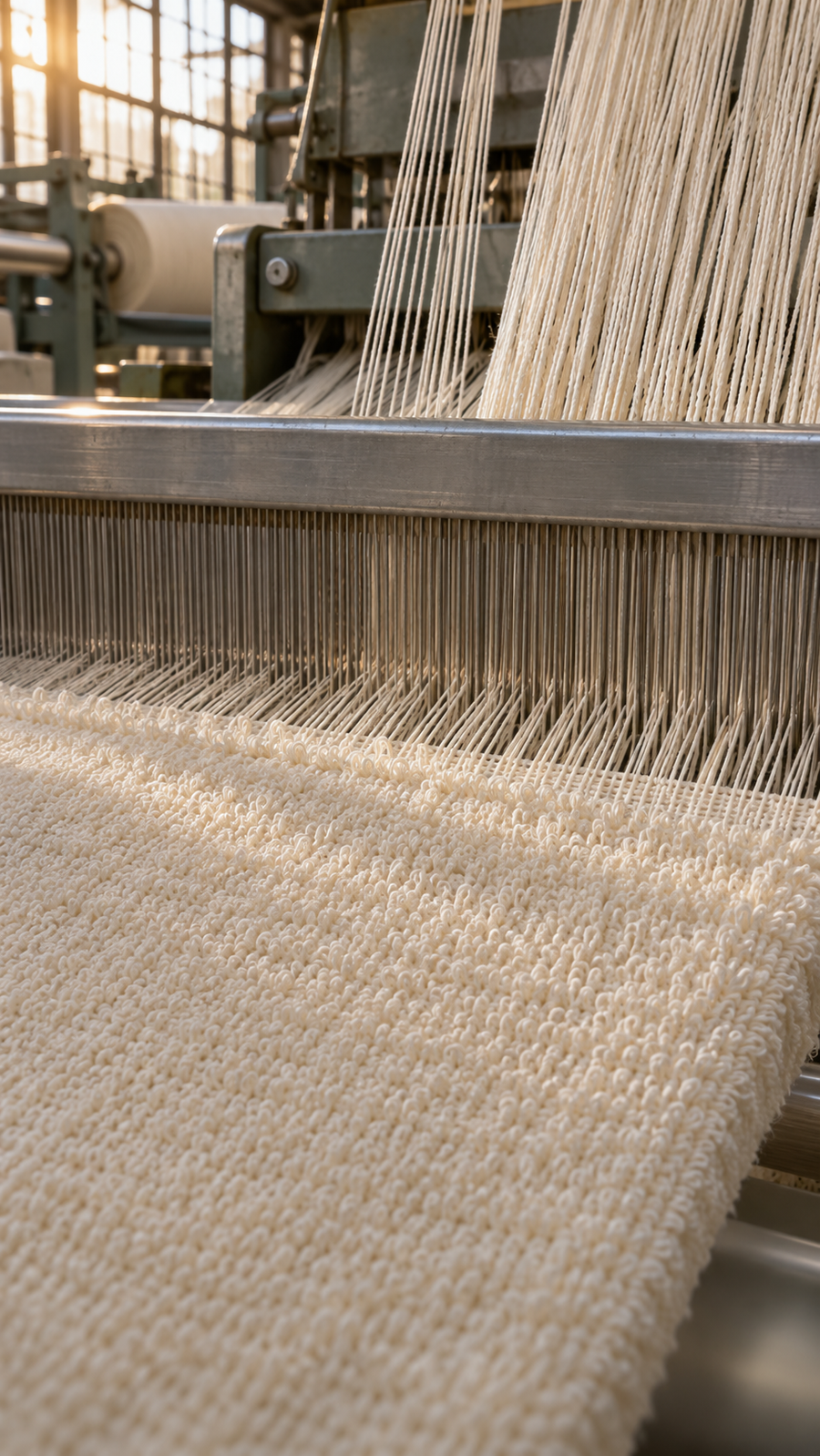
Before weaving, the lengthwise warp yarns are arranged side by side and prepared for the loom. During weaving, they interlace with the crosswise weft. In woven terry, additional pile yarns form small loops above the ground structure.
The loops you see when looking closely at a towel are an important part of its characteristic surface and help it take up water. The film’s weaving scene makes this change visible: a fine yarn becomes part of a fabric with depth and texture.
The fabric’s journey continues after the loom. The film moves from inspection to washing and preparation, dyeing, rinsing, drying and finishing. Appropriate preparation helps remove unwanted residues from cotton and readies it for later treatments.
This stage is about more than colour. Finishing can also influence the appearance of the fabric and how it feels in the hand. Treatments differ between products, so the composition and care information for the particular towel remain your guide.

The prepared fabric is cut to the intended towel dimensions and its edges are stitched. A broad textile surface becomes individual pieces for everyday use. The close-up of hemming in the film draws attention to an edge detail that is easy to overlook.
When you next pick up a towel, look beyond its centre to the edge line and corners. These small details are part of the finished appearance, and they remain visible even when the towel is neatly folded.

The film closes with checking, folding and packing. Production checks may assess features such as fabric appearance, dimensions or stitching; the checks required depend on the product specification. The fabric-inspection image below is a reminder that attention to detail begins before the packing stage.
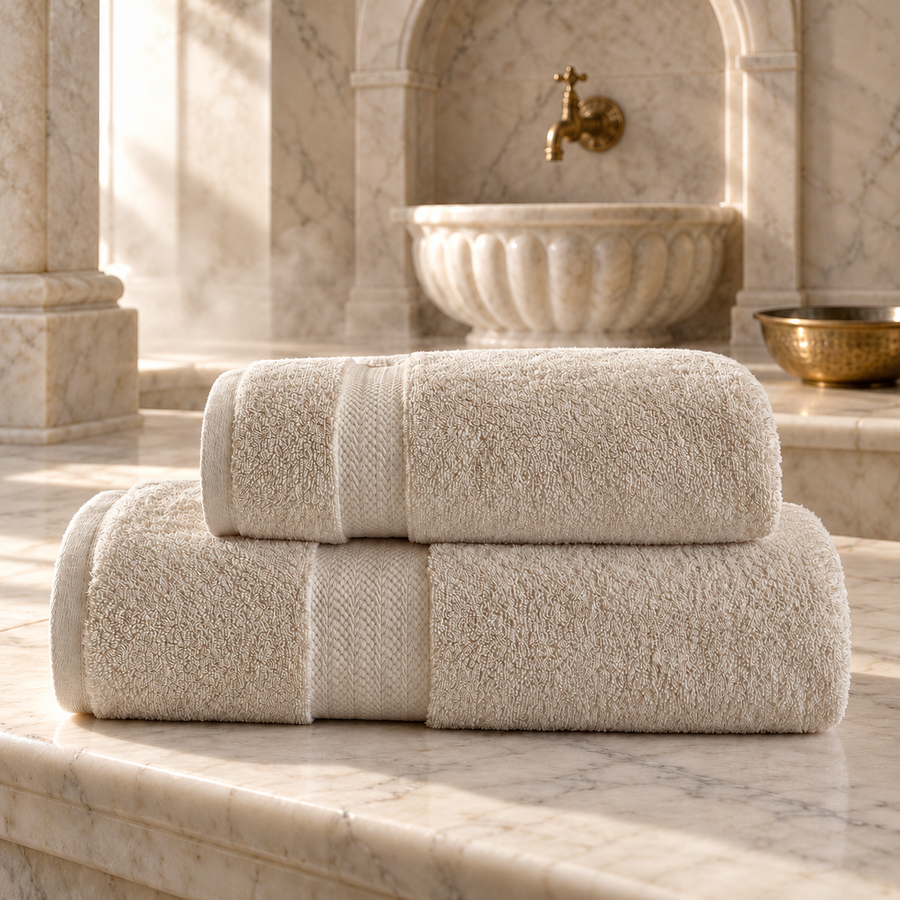
Then the story continues at home: beside the basin in the morning, after a shower, or on a clean shelf prepared for a guest. A journey that started with raw cotton arrives at something familiar, ready to become part of the day.

Next time you choose a towel, spend a moment with its texture, loops, edges and product information, as well as its colour. At Pavia Home, these small details are part of what makes everyday comfort worth noticing.
These illustrative images were created with AI for our Cotton to Towel film.
References for the general process descriptions: